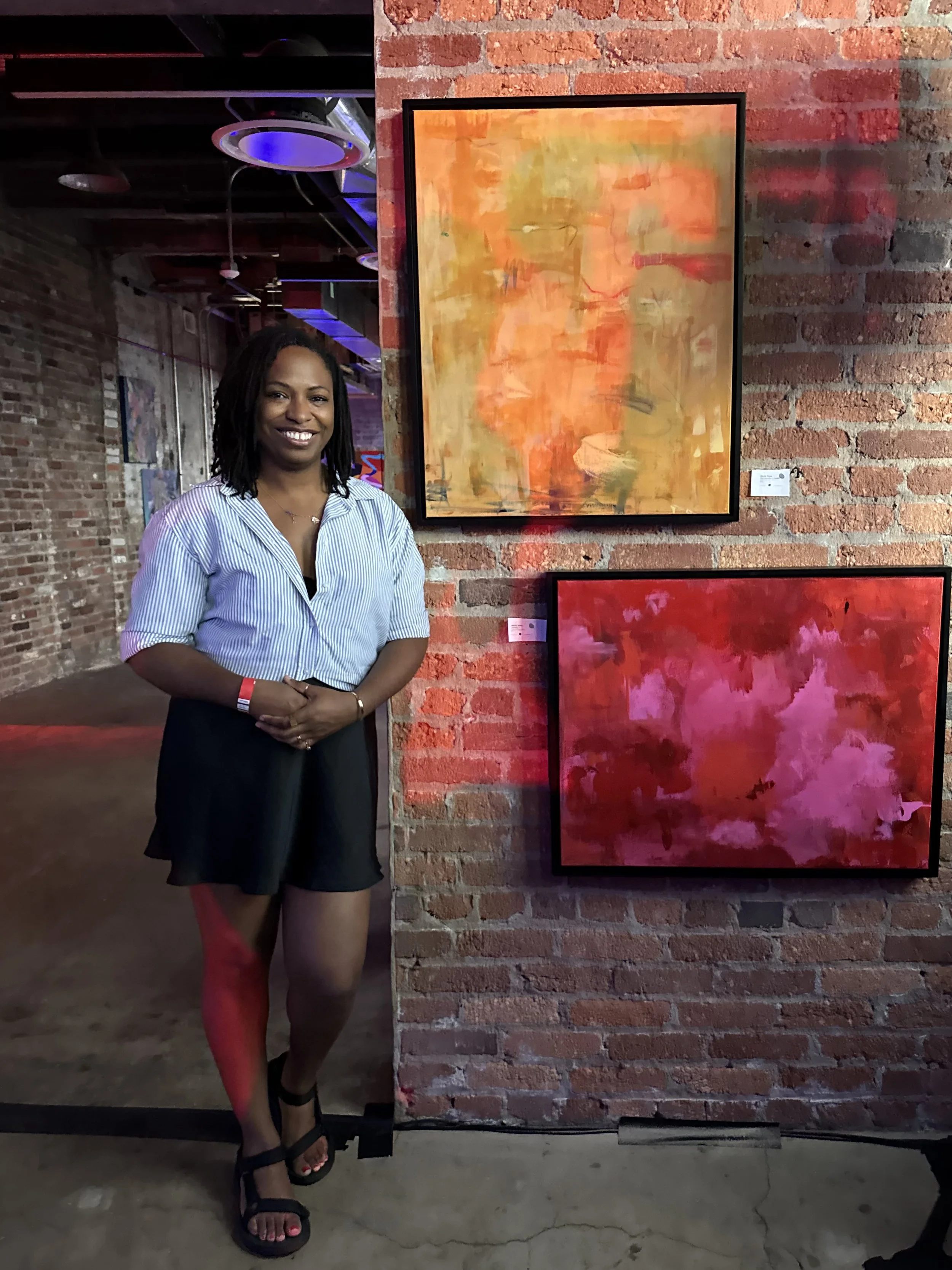
Bio
Nicole Theus (b. 1986, Berkeley, CA; lives and works in Washington, D.C.) is a painter working in abstraction, monoprint, and mixed media. Drawing on an academic foundation in Sociology and African and African American Studies, her practice engages the emotional and cultural registers of abstraction: examining how color, gesture, and layered surface can hold feeling, memory, and meaning without resolving into fixed narrative.
Theus works thoughtfully and intuitively, building compositions through accumulation and discovery. Music is central to her process: a needle dropped on a record, a playlist on shuffle, a song that ends up giving a finished piece its name. Sometimes the music shapes the painting from the first mark. Sometimes she finishes a piece and only later hears the song it was always becoming.
She grew up between the Bay Area and Monterey, California, and spent nearly a decade of her adult life in Oakland before moving to DC, a Californian at heart, through and through. A former college radio host and music podcaster, her background in the social sciences still shows up in how she thinks about identity, feeling, and meaning in visual work.
Though she has spent her professional life as an HR executive, Theus has been making art since childhood: photography, drawing, painting, creating continuously across decades. She began taking her practice seriously in college and has worked with artists and in workshops ever since. Now, after years of making work privately, she is stepping fully into public life as an artist.
Her paintings invite the kind of presence and interpretation music does; something felt before it's explained.
*As you browse her portfolio, take a look at the song associated with each piece!
Artist Statement
My paintings begin with curiosity: about color, emotion, and what can emerge when I loosen my attachment to a particular outcome. I work responsively, allowing each decision to suggest the next. I add, obscure, scrape away, reveal, and reconsider, attending as much to what the materials give me as to what I intended.
This process has become a way of exploring the tension between control and surrender. A painting may begin with a palette, a feeling, a song, or a loose idea of where I think it is going, but I am curious to see what emerges through the process. Accidents become possibilities. A passage I love may need to disappear for something else to emerge. At some point in every painting, I must release something I love.
Color is central to this exchange. I am drawn to luminosity, movement, and the accumulation of translucent and opaque layers. Music is often present as I work, not as something I am illustrating, but as part of the rhythm and emotional register of the painting. Through color, gesture, and material, I want to create paintings that are beautiful and emotionally resonant: spaces in which a viewer can linger and have an emotional experience of their own.
As a Black abstract artist, I am also interested in Édouard Glissant's concept of the “right to opacity,” the possibility of being seen without being fully explained. Abstraction allows both the painting and the viewer that freedom. Meaning can remain open. The experiences, memories, and associations embedded in the work do not need to resolve into a fixed narrative to be felt.
For me, painting is ultimately an ongoing practice of curiosity and trust: discovering what becomes possible when I stop insisting on knowing where something is going.